ABC music notation, explained and referenced
ABC notation is a way of writing music as plain text, so a tune fits in an email, a forum post or a text file and still renders as a score. This page explains it, shows a real tune, and then lists every symbol the standard defines.
What is ABC notation?
ABC is a text format for music. Notes are letters (C D E F G A B), octaves are case and marks (c is an octave above C, c' another octave up, C, an octave down), and durations are numbers after the note (A2 is twice the default length, A/2 half). Bar lines are |, repeats are |: and :|, and chord symbols sit in quotes before the note they accompany, like "G".
It was designed in the early 1990s by Chris Walshaw for folk and traditional tunes, which are mostly single melodies with chords, and that is still where it is used most: session repertoires, tune collections and teaching material for Irish, Scottish, Breton and other traditions. The current standard is ABC 2.1, and it covers far more than melodies: lyrics, multiple voices, ornaments, dynamics and typesetting directives.
Because it is text, ABC is easy to share, search and version, and a tune written in ABC can be rendered as standard notation, played back, exported to MIDI or MusicXML, and transposed without retyping it.
A tune written in ABC
Here is the first part of The Kesh, a jig played at sessions everywhere.
X:1
T:The Kesh
R:jig
M:6/8
L:1/8
K:G
|:"G"GAG GAB|"D"ABA ABd|"Em"edd gdd|"D"edB dBA|
"G"GAG GAB|"D"ABA ABd|"Em"edd gdB|"D"AGF "G"G3:|
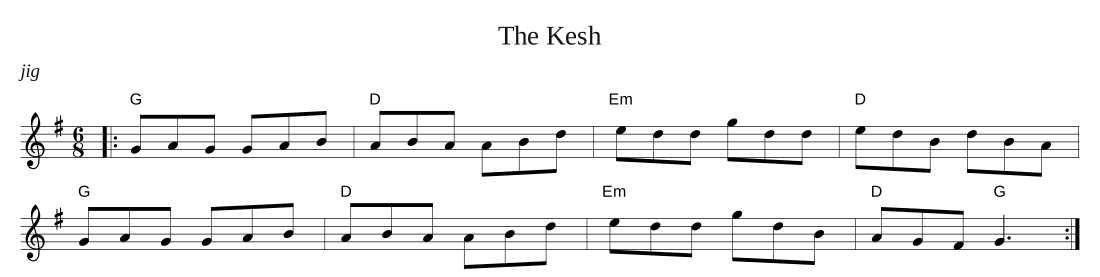
Read it line by line. K:G puts the tune in G major, so every F is sharp without writing it. L:1/8 makes an unmarked note an eighth, and M:6/8 groups them in twos of three per bar. G3 is a dotted quarter, three eighths long. The "G" before a group is a chord symbol for whoever accompanies; it does not change the melody. |: and :| play the eight bars twice.
Reading the header
X:- a reference number, needed once per tune
T:- the title
R:- the rhythm or tune type, such as jig, reel or hornpipe; optional but useful for players
M:- the meter
L:- the default note length
K:- the key, always the last header line before the music
Questions people ask
Is ABC notation free to use?
Yes. It is an open standard with a public specification, and any text editor can write it. Programs that render or play it exist for every platform, several of them free and open source.
Can I turn ABC into sheet music or sound?
Yes. A renderer such as abcjs draws the score from the text, and the same text can be played back or exported to MIDI and MusicXML. That is what this site does with every tune in your repertoire.
Where do I find tunes already written in ABC?
Traditional music sites such as The Session and the ABC notation tune search hold tens of thousands of tunes as ABC. AbcMusicStudio searches them from inside the editor.
How is ABC different from MusicXML or MIDI?
ABC is written and read by people; MusicXML and MIDI are exchange formats written by software. ABC is shorter, readable in a text message, and converts to both.
Is ABC only for folk music?
It is used most for folk and traditional tunes, but the standard supports several voices, lyrics, dynamics and articulation, and people write classical and choral pieces in it too.
Paste the tune above into AbcMusicStudio’s editor to see it rendered, hear it, slow it down, and transpose it. The Local plan is free.
Every ABC symbol, by group
Header Fields
X:- Reference/tune number — required, must be unique in the file
T:- Title
C:- Composer
O:- Origin
R:- Rhythm (e.g. reel, jig, waltz)
M:- Meter (e.g. 4/4, 6/8)
L:- Default note length (e.g. 1/8)
Q:- Tempo (e.g. "allegro" 1/4=120)
K:- Key [clef] [middle=x] — always the last header line
V:- Voice (e.g. V:4 clef=bass)
P:- Parts (e.g. P:A, P:ABAC, P:(A2B)3)
B:- Book
D:- Discography
F:- File URL
G:- Group (e.g. G:flute)
H:- History
I:- Instruction
N:- Notes (about the tune)
S:- Source
W:- Words (lyrics after the tune)
w:- Words (lyrics inline, under the staff)
Z:- Transcriber — also a good place for copyright info
m:- Macro (e.g. m: ~n2 = (3o/n/m/ n)
r:- Remark
s:- Symbol line (e.g. s: !pp! ** !f!)
U:- User-defined shortcut (e.g. U: T = !trill!)
Clefs & Voices
treble- Treble (default)
treble-8- Treble, 8ve below (e.g. tenors)
treble+8- Treble, 8ve above (e.g. piccolo)
bass- Bass
bass3- Baritone
alto4- Tenor
alto- Alto
alto2- Mezzo-soprano
alto1- Soprano
none- No clef
perc- Percussion
clef=- Clef of the voice
name=xxx- Name shown left of the first staff
sname=xxx- Short name shown left of later staves
merge- Places this voice on the same staff as the previous one
up / down- Forces the note stem direction
middle=<note>- Note on the middle line of the staff
Notes, Octaves & Duration
C,, C, C c c' c''- Octave markers around middle C
^- Sharp
^^- Double sharp
=- Natural
_- Flat
__- Double flat
z- Rest
Z- Whole-bar rest
x- Invisible rest
X- Invisible whole-bar rest
y- Spacer
-- Tie
( )- Slur
.-- Dotted tie
.( )- Dotted slur
-,- Tie below
(' )- Slur above
{/g}- Grace note
(3- 3 notes in the time of 2
(p:q:r- p notes in the time of q, for the next r notes
[ceg]- Chord
&- Overlay (temporary extra voice)
Repeats & Bar Lines
|- Bar line
|]- Final bar line
||- Double bar line (section break)
[|- Bold bar line at start
|:- Repeat start
:|- Repeat end
::- Repeat end + start
[|]- Invisible bar line
.|- Dotted bar line
[1 [2- First and second time repeats
Chord Symbols
m, min- Minor, e.g. "Am7"
maj- Major
dim- Diminished
aug, +- Augmented
sus- Suspended
7, 9 …- 7th, 9th, etc.
Lyrics (w: / W:)
-- Break between syllables within a word
_- Last syllable held for an extra note
*- One note is skipped
~- Appears as a space; puts multiple words under one note
\-- Appears as a hyphen; multiple syllables under one note
|- Advances to the next bar
Decorations — Short Forms
.- Staccato
~- Irish roll/turn
T- Trill
H- Fermata
L- Accent or emphasis
M- Inverted mordent
P- Mordent
S- Segno
O- Coda
J- Slide
R- Roll
u- Upbow
v- Downbow
Dynamics
!crescendo(! or !<(!- Start of a crescendo mark
!crescendo)! or !<)!- End of a crescendo mark, placed after the last note
!diminuendo(! or !>(!- Start of a diminuendo mark
!diminuendo)! or !>)!- End of a diminuendo mark, placed after the last note
!pppp! … !ffff! !sfz!- Volume levels from pianissississimo to fortissississimo, and sforzando
Ornaments
!trill!- Trill (also !trill(! / !trill)!)
!lowermordent!- Short squiggle with a line through it
!uppermordent!- Short squiggle
!mordent!- Same as !lowermordent!
!pralltriller!- Same as !uppermordent!
!accent! !>! !emphasis!- Accent mark (>)
!fermata! !invertedfermata!- Fermata / hold (arc above dot)
!tenuto!- Horizontal bar
!trem1/2/3/4!- Tremolo (on the 2nd note)
!xstem!- Stem points up to the staff above
!slide! !turnx! !invertedturn! !invertedturnx! !arpeggio!- Additional ornament marks
Text Annotations
"..."- Text above the note by default
"^..."- Above the staff
"_..."- Below the staff
"<..."- Left of the note
">..."- Right of the note
"@x,y ..."- Explicit offset
Fingering & Phrasing
!0! – !5!- Fingerings
!plus!- Left-hand pizzicato, or rasp for brass
!wedge!- Small filled-in wedge mark
!open!- Open string or harmonic (small circle above note)
!thumb!- Cello thumb symbol
!snap!- Snap-pizzicato mark
!turn!- Turn mark
!roll!- Roll mark (arc), as used in Irish music
!breath!- Breath mark (apostrophe) after the note
!shortphrase!- Vertical line on the upper part of the staff
!mediumphrase!- Same, extending down to the middle
!longphrase!- Same, extending 3/4 of the way down
!upbow!- V mark
!downbow!- Squared "n" mark
Repeat / Section Symbols
!segno!- Two "S"-like symbols separated by a diagonal
!coda!- A ring with a cross in it
!D.S.!- The letters "D.S." (Da Segno)
!D.C.!- The letters "D.C." (Da Capo)
!dacoda! !dacapo! !fine!- Additional navigation markers
Correct Order of Elements
<grace notes><chord symbols><decorations><accidentals><NOTE><octave><note length><tie>- The order ABC expects these to appear in, left to right
General MIDI Instruments
1- Acoustic Grand
2- Bright Acoustic
3- Electric Grand
4- Honky-Tonk
5- Electric Piano 1
6- Electric Piano 2
7- Harpsichord
8- Clavinet
9- Celesta
10- Glockenspiel
11- Music Box
12- Vibraphone
13- Marimba
14- Xylophone
15- Tubular Bells
16- Dulcimer
17- Drawbar Organ
18- Percussive Organ
19- Rock Organ
20- Church Organ
21- Reed Organ
22- Accordion
23- Harmonica
24- Tango Accordion
25- Acoustic Guitar (nylon)
26- Acoustic Guitar (steel)
27- Electric Guitar (jazz)
28- Electric Guitar (clean)
29- Electric Guitar (muted)
30- Overdriven Guitar
31- Distortion Guitar
32- Guitar Harmonics
33- Acoustic Bass
34- Electric Bass (finger)
35- Electric Bass (pick)
36- Fretless Bass
37- Slap Bass 1
38- Slap Bass 2
39- Synth Bass 1
40- Synth Bass 2
41- Violin
42- Viola
43- Cello
44- Contrabass
45- Tremolo Strings
46- Pizzicato Strings
47- Harp
48- Timpani
49- String Ensemble 1
50- String Ensemble 2
51- Synth Strings 1
52- Synth Strings 2
53- Choir Aahs
54- Voice Oohs
55- Synth Voice
56- Orchestra Hit
57- Trumpet
58- Trombone
59- Tuba
60- Muted Trumpet
61- French Horn
62- Brass Section
63- Synth Brass 1
64- Synth Brass 2
65- Soprano Sax
66- Alto Sax
67- Tenor Sax
68- Baritone Sax
69- Oboe
70- English Horn
71- Bassoon
72- Clarinet
73- Piccolo
74- Flute
75- Recorder
76- Pan Flute
77- Blown Bottle
78- Shakuhachi
79- Whistle
80- Ocarina
81- Lead 1 (square)
82- Lead 2 (sawtooth)
83- Lead 3 (calliope)
84- Lead 4 (chiff)
85- Lead 5 (charang)
86- Lead 6 (voice)
87- Lead 7 (fifths)
88- Lead 8 (bass+lead)
89- Pad 1 (new age)
90- Pad 2 (warm)
91- Pad 3 (polysynth)
92- Pad 4 (choir)
93- Pad 5 (bowed)
94- Pad 6 (metallic)
95- Pad 7 (halo)
96- Pad 8 (sweep)
97- FX 1 (rain)
98- FX 2 (soundtrack)
99- FX 3 (crystal)
100- FX 4 (atmosphere)
101- FX 5 (brightness)
102- FX 6 (goblins)
103- FX 7 (echoes)
104- FX 8 (sci-fi)
105- Sitar
106- Banjo
107- Shamisen
108- Koto
109- Kalimba
110- Bagpipe
111- Fiddle
112- Shanai
113- Tinkle Bell
114- Agogo
115- Steel Drums
116- Woodblock
117- Taiko Drum
118- Melodic Tom
119- Synth Drum
120- Reverse Cymbal
121- Guitar Fret Noise
122- Breath Noise
123- Seashore
124- Bird Tweet
125- Telephone Ring
126- Helicopter
127- Applause
128- Percussion (abcjs only)
Accented Characters
\`X- Grave accent, e.g. \`a → à
\'X- Acute accent, e.g. \'e → é
\^X- Circumflex, e.g. \^o → ô
\~X- Tilde, e.g. \~n → ñ
\"X- Umlaut/diaeresis, e.g. \"o → ö
\,X- Cedilla, e.g. \,c → ç
\oX- Ring, e.g. \oa → å
\/X- Slash, e.g. \/o → ø
\uX- Breve, e.g. \ua → ă
\vX- Caron, e.g. \vs → š
\HX- Double acute, e.g. \Ho → ő
\ss \AE \ae \oe- Ligatures: ß, Æ, æ, œ
©- Copyright symbol ©
\u266f \u266e \u266d- Sharp / natural / flat symbols (♯ ♮ ♭)
Extended Information Fields
%%abc-creator- Name/version of the tool that generated this file
%%abc-version 2.0- Use for pre-2.1 ABC
%%abc-charset iso-8859-1- Character set — default is UTF-8
%%abc-include mydefs.abh- Include an external definitions file
Page Format
%%pageheight <length>- Page height
%%pagewidth <length>- Page width
%%topmargin <length>- Top margin
%%botmargin <length>- Bottom margin
%%leftmargin <length>- Left margin
%%rightmargin <length>- Right margin
%%indent <length>- First-line indent
%%landscape <logical>- Landscape orientation
%%staffwidth <length>- Staff width
Fonts
%%titlefont- Title font (name + size)
%%subtitlefont- Subtitle font
%%composerfont- Composer font
%%partsfont- Parts font
%%tempofont- Tempo font
%%gchordfont- Chord symbol font
%%headerfont- Header font
%%historyfont- History (H:) font
%%footerfont- Footer font
%%annotationfont- Annotation font
%%infofont- Info line font
%%measurefont- Measure number font
%%repeatfont- Repeat text font
%%textfont- Body text font
%%voicefont- Voice name font
%%vocalfont- Vocal font (w:)
%%wordsfont- Words font (W:)
%%setfont-1/2/3/4 <ft> <sz>- Define $1–$4 inline font switches usable within an ABC string
Spacing
%%topspace <length>- Space above the title block
%%titlespace <length>- Space around the title
%%titleleft <logical>- Left-align the title instead of centering
%%titlecaps <logical>- Render the title in capitals
%%subtitlespace <length>- Space around the subtitle
%%composerspace <length>- Space around the composer line
%%aligncomposer <integer>- -1 left, 0 centre, 1 right
%%musicspace <length>- Space between composer line and first staff
%%partsspace <length>- Space around part labels
%%vocalspace <length>- Space around vocal lines
%%wordsspace <length>- Space around lyrics
%%textspace <length>- Space around free text blocks
%%infospace <length>- Space around the info line
%%staffsep <length>- Space between systems
%%sysstaffsep <length>- Space between staves within a system
%%barsperstaff <integer>- Fixed number of bars per staff line
%%parskipfac <number>- Space between parts
%%lineskipfac <number>- Space between lines of text
%%stretchstaff <logical>- Stretch staves to fill the page width
%%stretchlast <logical>- Stretch the last staff line too
%%maxshrink <number>- Maximum note-shrinking factor
%%maxstaffsep <length>- Maximum space between systems
%%maxsysstaffsep <length>- Maximum space between staves in a system
%%splittune <logical>- Allow a tune to split across pages
%%newpage- Force a page break
%%scale <number>- Scale everything
%%staves- Group voices into staves, e.g. [(SA)(TB)] for short score
%%vskip <length>- Vertical skip
Measure Numbering (%%)
%%measurefirst <integer>- Number of the first measure
%%barnumbers <integer>- Print a number every n bars
%%measurenb <integer>- Same as %%barnumbers
%%measurebox <logical>- Box around measure numbers
%%setbarnb <integer>- Set the current measure number
%%contbarnb <logical>- Continue numbering across repeats
%%alignbars <integer>- Align bars vertically for the next n lines
Text Blocks (%%)
%%text <ABC String>- Insert a text line
%%textoption <string>- Text block formatting option
%%center <ABC String>- Centered text line
%%begintext … %%endtext- Multi-line text block
%%sep [# # #]- Horizontal separator
%%header- Custom page header
%%footer- Custom page footer
Misc Directives (%%)
%%autoclef <logical>- Automatic clef selection
%%beginps … %%endps- Embed raw PostScript
%%bstemdown <logical>- Force bass-staff stems down
%%comball <logical>- Combine all voices
%%combinevoices <logical>- Combine voices sharing a staff
%%dateformat <string>- Date format
%%encoding <integer>- 0–6 for ISO-Latin-n
%%EPS <string>- Include an external EPS file
%%exprabove <logical>- Place expression marks above the staff
%%exprbelow <logical>- Place expression marks below the staff
%%flatbeams <logical>- Flatten beam angles
%%freegchord <logical>- Print '#', 'b' and '=' literally in chord symbols
%%gchordbox <logical>- Box around chord symbols
%%graceslurs <logical>- Slur grace notes to the main note
%%hyphencont <logical>- Continue lyric hyphenation across lines
%%infoline <logical>- Rhythm and origin on the same line
%%linebreak $ or ! or <EOL> or <none>- Character that marks a line break in the source
%%musiconly <logical>- Don't output lyrics
%%oneperpage <logical>- One tune per page
%%partsbox <logical>- Box around part labels
%%postscript <string>- Raw PostScript string
%%printparts <logical>- Print P: part labels
%%printtempo <logical>- Print the Q: tempo marking
%%sep <length> <length> <length>- Separator dimensions
%%shiftunison <logical>- Offset unison notes so both are visible
%%squarebreve <logical>- Draw breves as squares
%%slurheight <float>- Slur arc height — below 1.0 flattens
%%staff <number>- Use the nth staff
%%staffnonote <logical>- Hide staves with no notes
%%stemheight <float>- Note stem height
%%straightflags <logical>- Draw note flags straight instead of curved
%%timewarn <logical>- Show cautionary time signatures
%%tuplets <integer> <integer> <integer>- Tuplet number display options
%%vocalabove <logical>- Place vocals above the staff
%%withxrefs <logical>- Print the X: index in the title
%%writefields <fields> [<logical>]- Show/hide specific header fields
%%writehistory <logical>- Print the H: history field